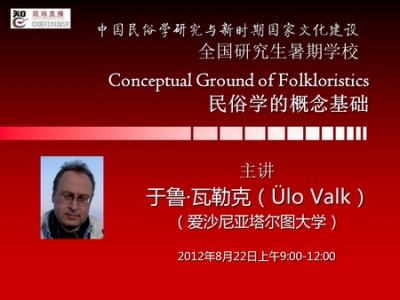
Ülo Valk
Professor of Estonian and Comparative Folklore
Ülo Valk is professor of Estonian and Comparative Folklore at the University of Tartu, Estonia. During 2003-2004 he is a Fulbright scholar at the Center for Folklore and Ethnography at the University of Pennsylvania. His research interests include genre theory, demonology and belief.
Degree information
Ülo Valk, Doctor's Degree, 1994, (sup) -, Eesti rahvausu kuradi-kujutelm (Image of the Devil in Estonian Folk Religion), University of Tartu
Honours & Awards
2006, Ülo Valk; Prize for Popularizing Estonian Science. II prize.
2006, Ülo Valk; Annual prize of the journal "Keel ja Kirjandus" in folkloristics
2003, Ülo Valk; The best Estonian Science Foundation grant project in the humanities ('Legend as a folklore genre')
2003, Ülo Valk; Flubright scholar at the University of Pennsylvania.
2002, Ülo Valk; Visiting Professor at the University of Kiel (Prof. Dr. Werner Petersen-Gastprofessur).
2000, Ülo Valk; Visiting professor in folkloristics at the University of California, Berkeley
1996, Ülo Valk; Prize of Academia Europaea for young scholars.
Field of research
2. Culture and Society, 2.6. Philology and Linguistics(vernacular religion and genre theory)
Current grants & projects
Folklore and Society: Tradition Memory, Creativity, Applications
Alternative Discourses of Belief: Folkloristic Perspectives
Centre of Excellence in Cultural Theory
Authority and Utopias in Estonian and Finnish Belief Narratives
Some recent publications:
'On the Connections between Estonian Folk Religion and Christian Demonology', Mitteilungen für Anthropologie und Religionsgeschichte, Band 8. Münster: Ugarit-Verlag, 1994
(pp. 191-209).
'The Black Gentleman: Manifestations of the Devil in Estonian Folk Religion', Folklore Fellows' Communications No. 276, Helsinki, 2001.
'Authorship and Textuality. Kalevipoeg as Epic Landscape', Kalevala and the Worlds Traditional Epics, ed. Lauri Honko. Studia Fennica Folkloristica 12. Finnish Literature Society: Helsinki, 2002 (pp. 405-417).
Career
Fall 2001: professor of Estonian and Comparative Folklore, University of Tartu;
2002 - 2003: chair of the Department of Literature and Folklore, University of Tartu;
2003 - 2004: visiting scholar at the Center for Folklore and Ethnography, University of Pennsylvania
2004: professor of Estonian and Comparative Folklore, University of Tartu
Administrative responsibilities
2010 - ... Member of the International Association of the History of Religions
2010 - ... Expert of the Finnish Academy (projects in cultural research)
2010 - ... Expert of grant projects of the Slovenian Research Agency
2009 - ... Member of the executive committee of the Estonian Society for the Study of Religions
2009 - ... Vice-President of the International Society for Folk Narrative Research (ISFNR)
2009 - ... Member of the editorial board of "Journal of Indian Folkloristics" (Mysore, India)
FFC 276
Ülo Valk:
The Black Gentleman: Manifestations of the Devil in Estonian Folk Religion.
Helsinki: Suomalainen Tiedeakatemia (Academia Scientiarum Fennica). 2001. 217 pp.
ISBN 951-41-0884-1 (hardback) 22 euros (hardback)
ISBN 951-41-0885-x (paperback) 18 euros (paperback)
This empirical study of the Devil in the collections of the Estonian Folklore Archives, reflecting the world of belief inhabited by the Estonians in the 19th and 20th centuries, is also a book about suspicion and fear in everyday life. It describes how religious folklore has drawn borders between the human and the non-human, how it has modelled the Other, the supernatural and social evil. As a study of folk narrative, and legends in particular, it mainly discusses variation at the level of motif with special reference to the visual guises of the Devil. These are projected against the backcloth of international folklore and demonological treatises on Christianity.
ÜLO VALK studied folklore, literature and Indology at the University of Tartu in the 1980s. He later worked as a researcher at the Folklore Department of the Institute of the Estonian Language and Literature, which in practice meant working in the national Folklore Archives. At present he is Professor of Estonian and Comparative Folklore at the University of Tartu. Dr Valk has done fieldwork in Estonia and India and has published articles on folk religion, demonology, legends and folksongs in Estonian and English. FFC 276 is a slightly revised version of his doctoral thesis, submitted to the University of Tartu in 1994 作者: silver 时间: 2012-8-21 18:43 标题: 于鲁·瓦勒克教授简介
IEL口传工作坊:编译
爱沙尼亚民俗与比较民俗学教授 (Professor of Estonian and Comparative Folklore)
目前就职于爱沙尼亚塔尔图大学塔尔图大学哲学系,文化和艺术研究所
研究领域:文化与社会;语文学与语言学;本地宗教与文类理论
研究兴趣:文类理论、鬼神学和信仰
于20世纪80年代在塔尔图大学从事民俗、文学和印度学研究,其教育背景为爱沙尼亚语文学研究(studies of Estonian philology 1980-1986);1994年在塔尔图大学获博士学位(语文学?)2003-2004年,作为富布赖特学者在美国宾夕法尼亚大学民俗与民族志研究中心访学。随后成为塔尔图大学爱沙尼亚语言与文学研究所民俗部的研究人员,那里开展的学术实践实际上意味着在国家民俗档案中工作。瓦尔克博士在爱沙尼亚和印度进行过实地调查,以爱沙尼亚语和英语发表过许多文章,涉及民间宗教,鬼神,传说和民歌的研究。
近期成果:
“著作权和文本性”作为史诗景观的 Kalevipoeg”,《卡勒瓦拉和世界传统的史诗》劳里·杭柯编,芬兰民俗学研究丛书(Studia Fennica Folkloristica),芬兰文学学会,赫尔辛基,2002年(第405-417)。
“爱沙尼亚民间宗教与基督教的恶魔观念”(论文),刊于Mitteilungen für Anthropologie und Religionsgeschichte, 明斯特:乌加里特出版社,1994年,页191-209。
个人代表作:《黑绅士:恶魔在爱沙尼亚的民间宗教中的表现》, FFC276,芬兰科学院,赫尔辛基,2001年。[The Black Gentleman: Manifestations of the Devil in Estonian Folk Religion, FFC276, Helsinki: Suomalainen Tiedeakatemia (Academia Scientiarum Fennica). 2001. ]
Bent af Klintberg的folklore概念阐释,走向一种广义,即traditional cultural forms,它们是人际间透过词语和行为来交流的,不再是简单的事项,而是交流与实践,tend to exist in variation(在变动中存在)。 作者: 风林火山 时间: 2012-8-22 09:42
补课:
Bengt af Klintberg
Bengt Knut Erik af Klingberg(1938-12-25出生于斯德哥尔摩Stockholm)是个瑞典人类学家,因撰写现代传说故事“The Rat in the Pizza(首版于1986年)" 和“The Stolen Kidney(首版于1994年)”吸引了大批观众而出名。
Klintberg与北欧博物馆(Nodic Musuem)馆长Christina Mattson长时间合作主持一个录音节目“Folkminnen(大众回忆或者口述传统)”,旨在鼓励听众写信描述或者提问有关当地传说,游戏,风俗,或其他民间传说(folklore)的起源和意义。在瑞典国家电台P1频道就任了750档(每周一期)之后,最后一期节目于2005年1月播出。如果你现在查一个普通的瑞典词语“urban legend(都市传说)”,Klintbergare的名字总是紧随其后。 作者: 南池子 时间: 2012-8-22 09:43
Richard Bauman and Charles L. Briggs (2003):
Voices of Modernity: Language Ideologies and the Politics of Inequality. New York: Cambridge University Press.


 今天的讲座快要开始了吧?
